Friday, June 27, 2008

One to One Innovation-CK Prahlad

CK Prahalad and M S Krishnan in their new book " The new age of innovation' drive home a very interesting point.
N=1 and R=G ( N= Personalised co created experiences , R=G Global access to resource and talent).

The book reveals that the key to creating value and the future growth of every business depends on accessing a global network of resources to co-create unique experiences with the customers, one at a time. Even if the company is dealing with a hundred million consumers, each manager must focus on one consumer experience at a time. The firm can provide the platform around which customers can co-create their own experiences. ( Eg Google, My Space , Apple IPod , Starbucks etc).

Check these links...
( Tutor Vista - Online Tu ting try spotting N=1 , R=G)
( Pomarfin - a Finnish company known for left foot concept, which offers customised footwear for men using foot scanning technology).

Thursday, June 26, 2008

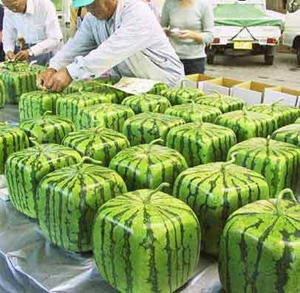
Lessons of the Square Watermelon

A great story doing round these day….This story is a great reminder of the power of creativity and innovation. The story revolves around the growing of square watermelons in Japan. I'm posting the story verbatim.


Japanese grocery stores had a problem. They are much smaller than their US counterparts and therefore don’t have room to waste. Watermelons, big and round, wasted a lot of space. Most people would simply tell the grocery stores that watermelons grow round and there is nothing that can be done about it. But some Japanese farmers took a different approach. ”If the supermarkets want a space efficient watermelon,” they asked themselves, “How can we provide one?” It wasn’t long before they invented the square watermelon.

The solution to the problem of round watermelons wasn’t nearly as difficult to solve for those who didn’t assume the problem was impossible to begin with and simply asked how it could be done. It turns out that all you need to do is place them into a square box when they are growing and the watermelon will take on the shape of the box.

Wednesday, June 25, 2008

Cognitive Inertia

How did Kodak respond to the threat of 'digital Camera' in 1980's ?What factors distinguish successful firms from unsuccessful firms?

It’s a common observation that many firms, especially large firms, are limited in their tendency to exploit the abundance of lucrative opportunities that surface from within the firm. As a result of the incumbent firm’s failure to support exploitation of these opportunities, some intra-preneurs are encouraged to become entrepreneurs by founding a start-up organization. In many a cases, founders of these new firms would have preferred to exploit their entrepreneurial discovery within their previous firm, given sufficient management support and resources.

So what went wrong? Research suggests that cognitive inertia is one powerful explanation as to why established firms are not as innovative as young, less established firms. Gladwell throws in a very interesting perspective to this.

Friday, June 20, 2008

The Ant philosophy by Jim Rohn

Over the years I've been teaching kids about a simple but powerful concept - the ant philosophy. I think everybody should study ants. They have an amazing four-part philosophy, and here is the first part: ants never quit. That's a good philosophy. If they're headed somewhere and you try to stop them, they'll look for another way. They'll climb over, they'll climb under, they'll climb around. They keep looking for another way. What a neat philosophy, to never quit looking for a way to get where you're supposed to go.

Second, ants think winter all summer. That's an important perspective. You can't be so naive as to think summer will last forever. So ants are gathering in their winter food in the middle of summer.
An ancient story says, "Don't build your house on the sand in the summer." Why do we need that advice? Because it is important to think ahead. In the summer, you've got to think storm. You've got to think rocks as you enjoy the sand and sun.