Showing posts with label Innovation. Show all posts
Showing posts with label Innovation. Show all posts
Monday, July 11, 2011


Thursday, May 19, 2011
Google Advisor : Making financial products comparison easy
Financial decisions are some of the most difficult decisions we face. Be it, finding the right credit card and mortgage or finding the right insurance product for our family. Due to information asymmetries, it becomes increasingly difficult to find the right product or option. While consumers now have instant access to more details than ever before, this has also made it much harder to find exactly what they want.
With this in mind, today, Google has rolled out a fantastic tool for consumers. Google Advisor is a comparison tool which allows users to get information on financial products. It enables you to compare offer options for your credit cards, checking and savings accounts, CDs or mortgage. With Google Advisor, the search company has entered the consumer finance comparison space. Currently, the service is only available in the United States and it is a matter of time before we see an international launch.
Sunday, May 15, 2011
Re-inventing Management for the 21st Century.
Management 1.0 was invented by people long dead or long retired, but with rapid change happening at an exponential pace, the organizations are facing a fundamentally 'different and new reality'. They face the world, where knowledge is fast becoming a commodity, and it is extremely difficult to have a sustainable differentiator.
Here in this short 15 minutes video of Prof Gary Hamel, celebrated management thinker and one of my favorite management 'gurus', makes a highly strong and passionate case for 'tearing down the old management structures and re-inventing the management practices relevant to the new-new world'.
The 'command and control' model of the industrial age is being challenged. A new management model more open, collaborative, flexible and adaptable to human beings is required. The 'Pyramid-Structure' of management is already giving way to 'amorphous' structure in this 'new knowledge world'.
Wednesday, April 20, 2011
The Rise of Social and P2P Lending Platforms: Transforming the Banking Landscape

Have you ever visited Zopa, Prosper, and Lending Club? For the uninitiated, these are some of the front-runners in the ‘rapidly’ evolving world of P2P (aka Social) Lending.
Peer to Peer lending goes by many names. It is also called social lending, person-to-person lending, or p2plending. However, It can be defined in a straightforward way: individuals lending money to other individuals through a platform without a banking intermediary.
P2p lending sites hope to disintermediate banks and get credit flowing to individuals and small businesses.
EBay + Facebook = Social Banking
These sites can be considered a combination of eBay and Facebook.com- a place where consumers come together to loan and borrow money from each other. The success of these web-based P2P lending communities can be assessed by the high growth in their numbers and loan volume.
Wednesday, April 13, 2011
The Rise of M-Commerce: How Mobile Devices Are Changing the Way We Shop
Some Statistics and trends:
- EBay generated $ 2 billion in global mobile sales in 2010 across 190 countries.
- PayPal’s worldwide mobile transactions have skyrocketed from $ 25 million in 2008 to $500 million in 2010.
- Smartphone sales grew 72% in 2010; 300 million smartphones were sold globally in 2010.
- There are over 3 billion mobile phones worldwide. Over 40% of the world’s population carries a mobile phone, far more than using a computer or having internet access.
- Mobile Phone is fast emerging as a ‘preferred’ transaction medium.
- Online Commerce is gaining share vs. Offline Commerce as consumers change their behavior and expectations with rapid development in technology.
The Mobile Commerce Opportunity
Any discussion of the potential opportunity must first start with a basic understanding of what we mean by “Mobile Commerce.” Mobile commerce comprises two categories: (1) Mobile banking and (2)Mobile payments; Money transfers. Mobile banking refers to situations where the mobile phone is an access channel for financial services. Mobile payments and money transfers apply to cases where the mobile phone is used as a payment device to affect the transfer of value from one party to another.
Wednesday, April 6, 2011
The Future of Education - Khan Academy
If you want to see the future of education...it is here...The Global One world Classroom...Watch this video by Sal Khan (Bill Gates Favorite teacher) and now imagine the possibilities.
Tuesday, March 29, 2011


Wednesday, March 16, 2011
Facebook Deals- Shifting business Models
Facebook Deals, when launched in Nov 2010, allowed users, who "check-in" at a location using Facebook Places (on their mobile phones) to receive rewards and offers via their mobile device.
But now, Facebook is extending this to include offers from local businesses. Soon Local businesses will be able to sign up to use this feature, and people will be able to find Deals.
But now, Facebook is extending this to include offers from local businesses. Soon Local businesses will be able to sign up to use this feature, and people will be able to find Deals.
So how does it work?, And how will it be different from daily-deal market leaders Groupon and LivingSocial?
Well to begin with–All deals offered on the Facebook platform will be around “social experiences,” i.e. “things you can do with your friends”; how will users pay for these deals? … this is where Facebook Credits become useful!
Well to begin with–All deals offered on the Facebook platform will be around “social experiences,” i.e. “things you can do with your friends”; how will users pay for these deals? … this is where Facebook Credits become useful!
To know more about How Facebook deals work? Check the following video
Facebook Credits has so far been used mainly for virtual goods, and occasionally for digital products, where Facebook currently takes a significant cut (30 percent) for the virtual currency, though Groupon and LivingSocial both take roughly 50 percent of the revenue for a given deal.
Deals also put Facebook on a collision path with Groupon and Living Social, in social commerce space, and with Google in advertisement space and income. Although it will be very hard for Facebook to compete with market leader Groupon, when it comes to social network, it has one huge advantage: 600 million+ users.
Important: Facebook/Social commerce has the potential to disrupt several business models. For example, Retail banking with augmented reality- How about a bank branch inside FACEBOOK?
Not a remote possibility, especially when we already have bank branches inside Wal-Mart’s and TESCO's. Any Peer2Peer or Mobile Service provider can offer all these banking services at the place and time of customers preference. It is important to understand that the business of banking is changing. In an interesting way, you do not need a bank license to participate in the banking industry ( e.g., M-Pesa, ZOPA, PayPAL). Will talk more about this in my later posts.
Update: 25 April 2011: Facebook launches Deals against Groupon and LivingSocial in five major cities. The Deals launch will also be the first major push for Facebook’s virtual currency, Facebook Credits. Users will use credits to purchase offers from its Deals service.
Not a remote possibility, especially when we already have bank branches inside Wal-Mart’s and TESCO's. Any Peer2Peer or Mobile Service provider can offer all these banking services at the place and time of customers preference. It is important to understand that the business of banking is changing. In an interesting way, you do not need a bank license to participate in the banking industry ( e.g., M-Pesa, ZOPA, PayPAL). Will talk more about this in my later posts.
Update: 25 April 2011: Facebook launches Deals against Groupon and LivingSocial in five major cities. The Deals launch will also be the first major push for Facebook’s virtual currency, Facebook Credits. Users will use credits to purchase offers from its Deals service.
Tuesday, November 23, 2010
Wednesday, September 15, 2010
Innovation and Collaboration
Delivered a talk at IMRB(Indian Marketing Research Bureau), Delhi on 10 Sept 2010. Here is the presentation..
Also here are few quotes on Creativity:
Also here are few quotes on Creativity:
- "The things we fear most in organizations - fluctuations, disturbances, imbalances - are the primary sources of creativity." - Alfred North Whitehead
- "The chief enemy of creativity is 'good" sense.'" - Pablo Picasso
- "As competition intensifies, the need for creative thinking increases. It is no longer enough to do the same thing better, no longer enough to be efficient and solve problems." - Edward de Bono
- "Creativity is thinking up new things. Innovation is doing new things." - Theodore Levitt
Tuesday, June 16, 2009
Cell Phones- Transforming Rural Life
Just saw this wonderful presentation by Iqbal Quadir: The power of the mobile phone to end poverty. Iqbal is the founder of hugely successful Grameen Phone.
I am convinced about the power of Mobile telephony as an effective poverty reduction tool. Experiences like the Grameen Phone have shown that provision of phone connectivity to a village serves several purpose- it leads to the economic development by helping individuals and business gain economic efficiency through communications; it promotes social and economic development for individuals who own and operate the telephone enterprises.
One of the basic principles of the Information Age is that information can be a source of power, efficiency and cost savings.
Friday, March 20, 2009
Delivering Happiness -Zappos.com
Here is an excellent presentation by Tony Hsieh -CEO Zappos.com
Please note the vision statement:
"One day, 30% of all retail transactions in the US will be online. People will buy from the company with the best service and the best selection. Zappos will be that company" Important point to note..'they call themselves 'service company' not 'shoe or clothing company'.Most important - their product is 'happiness'
Zappos - SXSW - 3-14-09
View more presentations from zappos
Wednesday, March 11, 2009
It is okay to fail...

-How important do people in your organization see innovation to be in their day-to-day jobs?
-How well is your organization recognizing and exploiting the diversity of its people's talent?
-To what degree does senior management encourage innovation by demonstrating that- 'it is okay to fail'?
We see organizations struggling to create a sustainable culture of innovation. We know that mistakes and failures are a critical part of the innovation process, but what is required is an attitude towards acceptance of failure.
Wednesday, February 4, 2009
How are you different?
Thinking about Future..... read a very interesting quote today. "Any piece of knowledge I acquire today has a value at this moment exactly proportioned to my skill to deal with it. Tomorrow, when I know more, I recall that piece of knowledge and use it better." - Mark Van Doren.
Truth be told , this statement succinctly captures the essence( and future) of knowledge worker. How will you differentiate your self in future? Is it on the basis of information you hold(or have access to)?
Fundamentally speaking information will cease to be the differentiator.Everyone would have access to any(read same) information that one needs. Google is just a step in that direction( any information/or the source of information is just a click away); Web 2.0 will look at creating more interactive tools for the Users.
So what is it, that will differentiate a Knowledge worker?
Monday, February 2, 2009
The economics of giving it away
Tough time calls for questioning!....especially in a period when ‘free’ goods and services online are becoming more and more popular…what are the challenges that entrepreneurs & business leaders face today ? Why the ‘zero-sum’ model doesn’t work alone?
How to monetize services when you are operating in a ‘freemium economy’- An economy where ‘few’ pay but ‘many’ use?. Imagine would some of the larger web 2.0 companies be around if it wasn’t for free services. Would consumers pay for Facebook, MySpace or Digg? I think the answer in most cases is ‘no.’
I think online businesses will have to look at providing real value to the users. Paid subscriptions can work only where there is true additional value provided. (LinkedIn is a good example)
So with the changing marketspace, Web startups now are having to comeup with a business model that brings in real money while they are still young.
Chris Anderson has a very interesting take on ‘the economics of giving it away’. He talks about the rapid shift in business model (mostly online) and why now ‘cash-flow’ is the king. I think this is a good read for anyone interested in online space. Chris has an advice for all would be entrepreneurs – ‘it’s now time to innovate, not just with new products but with new business models’.
Monday, September 22, 2008
What is Tuangou?
The power of groups, the clout that crowds can exercise to get what they want, is nothing new. What is new, however, is the dizzying ease with which like minded, action-ready citizens and consumers can now go online and connect, group and ultimately exert influence on a global scale.
Welcome to the world of 'CROWDShopping'.
Tuangou.es is a collective buying website in Spain. Tuangou essentially means (in Chinese of course!) 'tuan' -group and 'gou' - buy. Tuan gou ( teambuying in chinese) emerged from china in online chat-rooms,and graduated to more organised websites. Popular Chinese sites that are enabling crowds to first group online and then plan for real world shopmobbing are TeamBuy, Taobao and Liba.
Thursday, June 26, 2008
Lessons of the Square Watermelon
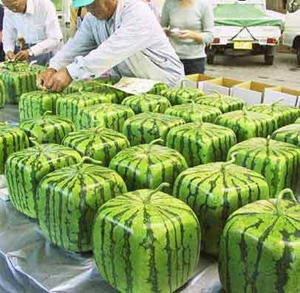
A great story doing round these day….This story is a great reminder of the power of creativity and innovation. The story revolves around the growing of square watermelons in Japan. I'm posting the story verbatim.

Japanese grocery stores had a problem. They are much smaller than their US counterparts and therefore don’t have room to waste. Watermelons, big and round, wasted a lot of space. Most people would simply tell the grocery stores that watermelons grow round and there is nothing that can be done about it. But some Japanese farmers took a different approach. ”If the supermarkets want a space efficient watermelon,” they asked themselves, “How can we provide one?” It wasn’t long before they invented the square watermelon.
The solution to the problem of round watermelons wasn’t nearly as difficult to solve for those who didn’t assume the problem was impossible to begin with and simply asked how it could be done. It turns out that all you need to do is place them into a square box when they are growing and the watermelon will take on the shape of the box.
Wednesday, June 25, 2008
Cognitive Inertia

It’s a common observation that many firms, especially large firms, are limited in their tendency to exploit the abundance of lucrative opportunities that surface from within the firm. As a result of the incumbent firm’s failure to support exploitation of these opportunities, some intra-preneurs are encouraged to become entrepreneurs by founding a start-up organization. In many a cases, founders of these new firms would have preferred to exploit their entrepreneurial discovery within their previous firm, given sufficient management support and resources.
So what went wrong? Research suggests that cognitive inertia is one powerful explanation as to why established firms are not as innovative as young, less established firms. Gladwell throws in a very interesting perspective to this.
Thursday, May 1, 2008
Seven Highly Effective Ways to Kill Innovation

Come on Smart guys,Do your Innovation Check....
Innovation killer#1: Believe that innovation will “just happen.”
Innovation killer#2: Tell everyone to “think outside of the box,” hold a brainstorming session, then call it a day.
Innovation killer#3: Lay the success of innovation solely on IT’s shoulders.
Innovation killer#4: Create an obstacle course for ideas.
Innovation killer#5: View “different” and “new” as bad.
Innovation killer#6: Hand over the good ideas to the Legal and Accounting departments.
Innovation killer#7: Be very, very afraid of failure.
Complete article is available here :
Sunday, April 6, 2008
Democratization of Innovation
Schumpeter model of Innovation states that . ‘a disruptive innovation is a technological innovation, product, or service that uses a “disruptive” strategy, rather than a “revolutionary” or “sustaining” strategy, to overturn the existing dominant technologies or status quo or products in a market’.
In many ways innovation is the single most important building block of competitive advantage… giving a company something unique that its competitors lack.
Innovations can be thought of as falling onto a continuum from evolutionary to revolutionary and therefore categorised into two groups:(1) Incremental or evolutionary innovations that improve the performance of established products, services or business models; or(2) Disruptive breakthroughs which lie at the core of entrepreneurial activity and serve as the basis of future technologies, products, services and industries.
In many ways innovation is the single most important building block of competitive advantage… giving a company something unique that its competitors lack.
Innovations can be thought of as falling onto a continuum from evolutionary to revolutionary and therefore categorised into two groups:(1) Incremental or evolutionary innovations that improve the performance of established products, services or business models; or(2) Disruptive breakthroughs which lie at the core of entrepreneurial activity and serve as the basis of future technologies, products, services and industries.
Subscribe to:
Posts (Atom)