Showing posts with label Power of Ideas. Show all posts
Showing posts with label Power of Ideas. Show all posts
Monday, July 11, 2011


Wednesday, April 6, 2011
The Future of Education - Khan Academy
If you want to see the future of education...it is here...The Global One world Classroom...Watch this video by Sal Khan (Bill Gates Favorite teacher) and now imagine the possibilities.
Wednesday, February 23, 2011
Thursday, February 19, 2009
Facebook retracts?...but why?
Something very interesting happened yesterday….
In a late-night blog post responding to the recent outcry over a recent change to Facebook's terms of service, CEO Mark Zuckerberg said the social network's TOS will revert to a previous version.
So what really happened? If you dig deep, you will notice the real reason behind this retraction. Facebook found itself in an unenviable position in the face of strong public activism. Now this public/consumer activism is not something new, but of late this silent force has gathered quite a momentum with advent of technology. So here we had 80,000 + facebook users signing up for People against the new Terms of Service’. Facebook certainly was not prepared for this backlash from its own user base.
Most organizations today are grappling with a force that they don’t understand, one that is growing all the time. This force is broad, ever shifting, ever growing, and it is global. It encompasses blogs, discussion groups, Wiki’s, You tube... Consumers whom we have never met are rating the company’s products in public forums that we have no experience with or no way to influence.
Sunday, December 14, 2008
Awakening Entrepreneurship: (Jagriti Yatra 2008)
I wanted to do something similar for a long period of time- get to know the real India, meet up with social and business entrepreneurs, understand what drives them, study their business model and assess the impact, and all this in a highly charged up environment with bright, young, and ‘fresh’ minds.
Surely enough,I signed up for TATA Jagriti Yatra, the moment my friend Jayanti Datta told me about it. This is going to be exciting- 18 days on a train, 13 villages and town, exchanging ideas with 350 + participants, 8000 km, meeting and learning from 18-20 real ‘change makers’.
Tata Jagriti Yatra '08 ( 24 Dec 08 to 11 Jan 09) is a train journey across India to meet with and learn from bottom-up innovators and entrepreneurs who are changing and challenging the definition of ‘Impossible’ at a grass-root level.
Sunday, October 26, 2008
Is it still a logo ? if it changes everyday
I asked a simple question to some of my friends in Branding,Marketing,and Advertisement -" Why is a company Logo important?and if it changes everyday-Is it still a logo?.
I was frowned upon at first and then in a very kotleresque manner was doused with marketing gyan; some obvious answers..
- A good and unique logo is the first step to achieve brand recognition;
- It shows what the company is about and it attracts people and is a good marketing tool to market the product;
- A companies advertising and promotional efforts should be centered around brand image. A logo represents that image without saying anything. Its an extension of the brand and should merit its qualities; etc
Well I don't' disagree with the marketing and traditional views, but was wondering :-" Do we place too much importance on a Logo?". Google is a company that changes its logo almost everyday, and still is one of the most popular brands.
My quest led me to an interesting old post by Doug Edwards -director of consumer marketing and brand management for Google 1999-2005.
I will be happy to hear from readers what they think about this.....
Monday, September 22, 2008
What is Tuangou?
The power of groups, the clout that crowds can exercise to get what they want, is nothing new. What is new, however, is the dizzying ease with which like minded, action-ready citizens and consumers can now go online and connect, group and ultimately exert influence on a global scale.
Welcome to the world of 'CROWDShopping'.
Tuangou.es is a collective buying website in Spain. Tuangou essentially means (in Chinese of course!) 'tuan' -group and 'gou' - buy. Tuan gou ( teambuying in chinese) emerged from china in online chat-rooms,and graduated to more organised websites. Popular Chinese sites that are enabling crowds to first group online and then plan for real world shopmobbing are TeamBuy, Taobao and Liba.
Monday, September 15, 2008
McKnight Principles

William L. McKnight, who served as 3M chairman of the board from 1949 to 1966, encouraged 3M management to "delegate responsibility and encourage men and women to exercise their initiative."
His management theories are the guiding principles for 3M. His basic rule of management was laid out in 1948:
"As our business grows, it becomes increasingly necessary to delegate responsibility and to encourage men and women to exercise their initiative. This requires considerable tolerance. Those men and women, to whom we delegate authority and responsibility, if they are good people, are going to want to do their jobs in their own way."Mistakes will be made.
Sunday, July 27, 2008
The art of collecting stories
Thursday, June 26, 2008
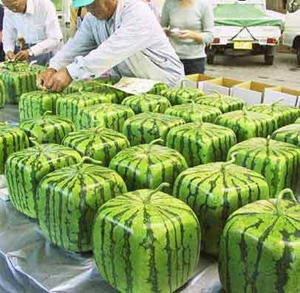
Lessons of the Square Watermelon
A great story doing round these day….This story is a great reminder of the power of creativity and innovation. The story revolves around the growing of square watermelons in Japan. I'm posting the story verbatim.

Japanese grocery stores had a problem. They are much smaller than their US counterparts and therefore don’t have room to waste. Watermelons, big and round, wasted a lot of space. Most people would simply tell the grocery stores that watermelons grow round and there is nothing that can be done about it. But some Japanese farmers took a different approach. ”If the supermarkets want a space efficient watermelon,” they asked themselves, “How can we provide one?” It wasn’t long before they invented the square watermelon.
The solution to the problem of round watermelons wasn’t nearly as difficult to solve for those who didn’t assume the problem was impossible to begin with and simply asked how it could be done. It turns out that all you need to do is place them into a square box when they are growing and the watermelon will take on the shape of the box.
Friday, January 18, 2008
Social Lending-Prosper
Who needs a bank to borrow money ? surprised !!..well check these few links Prosper , Zopa
The idea behind Prosper, and a handful of sites like it, is to allow peer-to-peer lending. It's lending enabled in large part by technology that allows bite-size payments to be processed online profitably.
(Prosper is founded by Chris Larsen, one of the old hands at consumer finance).
The website lets lenders bid against each other on the interest rates they are prepared to offer to specific borrowers.
There are risks, to be sure. The biggest is defaults. Prosper's average net default rate—based on the amount of money that is defaulted after collections—from Nov. 1, 2005, through Dec. 31, 2007, for all credit grades was 4%. That's roughly in line with defaults on credit cards. Portfolio size is approx USD 140 Mn.
What needs to be seen is how this model will evolve? Is the model scalable? How is money collected in case of default and cost implications? Also data on Operating Leverage or NIM would help...
The idea behind Prosper, and a handful of sites like it, is to allow peer-to-peer lending. It's lending enabled in large part by technology that allows bite-size payments to be processed online profitably.
(Prosper is founded by Chris Larsen, one of the old hands at consumer finance).
The website lets lenders bid against each other on the interest rates they are prepared to offer to specific borrowers.
There are risks, to be sure. The biggest is defaults. Prosper's average net default rate—based on the amount of money that is defaulted after collections—from Nov. 1, 2005, through Dec. 31, 2007, for all credit grades was 4%. That's roughly in line with defaults on credit cards. Portfolio size is approx USD 140 Mn.
What needs to be seen is how this model will evolve? Is the model scalable? How is money collected in case of default and cost implications? Also data on Operating Leverage or NIM would help...
Monday, January 14, 2008
Facebook as Intranet
Sometime back i heard this story that Serena Software is making 'Facebook' it's official Intranet. I did not believe it, but here it is...
http://www.fastforwardblog.com/2007/11/28/serena-has-adopted-facebook-as-their-intranet/
Welcome Enterprise 2.0 !
What Next..Employee less organisation - not that far fetched what say?
http://www.fastforwardblog.com/2007/11/28/serena-has-adopted-facebook-as-their-intranet/
Welcome Enterprise 2.0 !
What Next..Employee less organisation - not that far fetched what say?
Thursday, December 20, 2007
KIVA – Loans that change lives
While reading Stanford News Magazine came across this story:

Kiva means “unity” in Swahili, and was founded in October 2005 by Matt and Jessica Flannery ( Stanford University Alumni)
What ? :Kiva Microfunds is an organization that allows people to lend money via the Internet to small businesses in developing countries
How it Works ? :Kiva allows microfinance institutions around the world, called "Field Partners", to post profiles of qualified local entrepreneurs on its website. Lenders browse and choose an entrepreneur they wish to fund. Kiva aggregates loan capital from individual lenders and transfers it to the appropriate Field Partners to disburse and administer. As the entrepreneurs repay their loans, the Field Partners remit funds back to Kiva. Once a loan is fully repaid, the Kiva lenders can withdraw their principal or re-loan it to another entrepreneur.
Thursday, December 6, 2007
The Wisdom of Crowds

James Surowiecki’s The Wisdom of Crowds: Why the Many Are Smarter Than the Few and How Collective Wisdom Shapes Business, Economies, Societies and Nations makes a good read.
The book talks about the aggregation of information in groups, resulting in decisions that, he argues, are often better than could have been made by any single member of the group.
However , Not all crowds (groups) are wise. Consider, for example, mobs or crazed investors in a stock market bubble. Etc.According to Surowiecki, these key four elements are required to form a ‘wise crowd’.
Diversity of opinion -Each person should have private information even if it's just an eccentric interpretation of the known facts.
Independence -People's opinions aren't determined by the opinions of those around them.
Decentralization -People are able to specialize and draw on local knowledge.
Aggregation –Some mechanism exists for turning private judgments into a collective decision
A must read....
Thursday, November 8, 2007
'Quiet Time' & ' No- Email' Day at INTEL
Read the company blog.........a great step!
http://blogs.intel.com/it/2007/10/quiet_time_on_track_no_email_d.php.
Sunday, September 16, 2007
Honeybee Network - Grassroot Innovation
http://knownetgrin.honeybee.org/honeybee.htm
Check out the above link …It is about a remarkable person and a remarkable organisation.The HoneyBee Network was incubated by Prof. Anil Gupta at IIM Ahmedabad in 1988. The Network uncovers and documents grass root innovations from rural and small town India and tries to spread the knowledge and helps the inventors get a fair economic reward for their creativity.
Check out the above link …It is about a remarkable person and a remarkable organisation.The HoneyBee Network was incubated by Prof. Anil Gupta at IIM Ahmedabad in 1988. The Network uncovers and documents grass root innovations from rural and small town India and tries to spread the knowledge and helps the inventors get a fair economic reward for their creativity.
Friday, September 14, 2007
Crowdsourcing- The Long Tail
The word was first coined by Jeff Howe in a June 2006 Wired magazine article.
Wiki : Crowd sourcing is a neologism for the act of taking a task traditionally performed by an employee or contractor, and outsourcing it to an undefined, generally large group of people, in the form of an open call. For example, the public may be invited to develop a new technology, carry out a design task, refine an algorithm or help capture, systematize or analyze large amounts of data (see also citizen science).
The term has become popular with business authors and journalists as shorthand for the trend of leveraging the mass collaboration enabled by Web 2.0 technologies to achieve business goals.

Recently read "The Long Tail " by Chris Anderson . It is a must read for anyone who wants to understand the future of business. The book gives a very interesting perspective on : what happens when there is almost unlimited choice? It also shows why online models Amazon, Ebay etc are so successful by adhering to the 'rules' of long tail.
The future of business does not lies in 'hits' but in 'misses' ( the endless long tail). He refers to the concept of 'crowd-sourcing' quite liberally. Some examples of crowdsourcing that come to my mind...Wikipedia , InnoCentive, Threadless , Amazon , Netflix etc
Subscribe to:
Posts (Atom)